
Currently Empty: ₹0.00
March 13, 2026
0
Geeks Analytics
Types of Data Analytics Explained with Practical Examples
Data analytics plays a crucial role in how organizations understand information and make decisions. However, not all data analysis serves the same purpose. Businesses use different types of data analytics depending on the questions they want to answer from understanding past performance to predicting future outcomes.
In this blog, we explain the four main types of data analytics descriptive, diagnostic, predictive, and prescriptive analytics with practical examples to help beginners clearly understand how each type works in real-world scenarios.
Why Understanding the Types of Data Analytics Matters
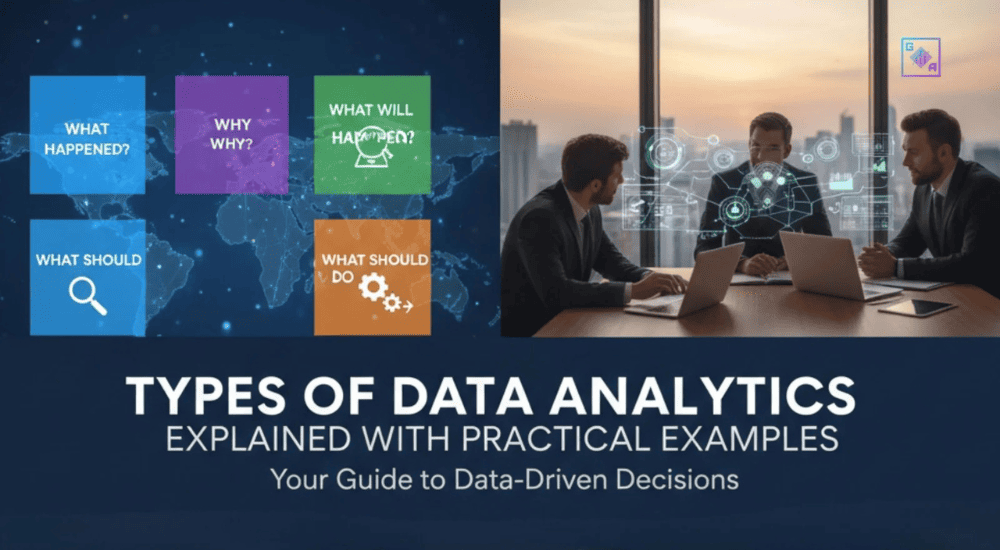
Each analytics type answers a different business question:
- What happened?
- Why did it happen?
- What will happen next?
- What should we do about it?
Knowing which type to use helps businesses make accurate, timely, and cost-effective decisions.
1. Descriptive Analytics – Understanding What Happened
What Is Descriptive Analytics?
Descriptive analytics summarizes historical data to describe past events. It focuses on trends, patterns, and key performance indicators (KPIs).
Common Tools Used
- Excel
- SQL
- Power BI
- Tableau
Practical Example
A retail company reviews monthly sales reports to understand:
- Total revenue
- Best-selling products
- Region-wise performance
This helps management assess overall performance but does not explain why changes occurred.
Business Use Cases
- Sales performance reports
- Website traffic summaries
- Monthly financial statements
2. Diagnostic Analytics – Understanding Why It Happened
What Is Diagnostic Analytics?
Diagnostic analytics goes deeper into data to identify the reasons behind outcomes. It involves data drilling, correlations, and comparisons.
Practical Example
If sales dropped in March, diagnostic analytics may reveal:
- Reduced footfall
- Increased competition
- Pricing changes
Techniques Used
- Drill-down analysis
- Root cause analysis
- Data segmentation
Business Use Cases
- Identifying causes of customer churn
- Analyzing campaign failures
- Understanding operational issues
3. Predictive Analytics – Understanding What Will Happen Next
What Is Predictive Analytics?
Predictive analytics uses historical data, statistical techniques, and machine learning to forecast future outcomes.
Practical Example
An e-commerce company predicts demand for products during festive seasons using past sales data and seasonal trends.
Tools and Techniques
- Regression analysis
- Time-series forecasting
- Machine learning models
Business Use Cases
- Sales forecasting
- Demand prediction
- Customer churn prediction
4. Prescriptive Analytics – Understanding What Should Be Done
What Is Prescriptive Analytics?
Prescriptive analytics recommends actions by evaluating possible outcomes and constraints.
Practical Example
A logistics company uses prescriptive analytics to determine optimal delivery routes that minimize cost and time.
Business Use Cases
- Pricing optimization
- Resource allocation
- Supply chain optimization
How Businesses Use All Four Types Together
Most organizations use a combination of all four analytics types:
- Descriptive: What happened?
- Diagnostic: Why did it happen?
- Predictive: What will happen?
- Prescriptive: What should be done?
This layered approach ensures better decision-making.
Conclusion
Understanding the types of data analytics helps businesses choose the right analytical approach for their goals. For aspiring analysts, mastering these types is essential for solving real-world problems and delivering actionable insights.
Related Posts
March 13, 2026
0
Geeks Analytics
Types of Data Analytics Explained with Practical Examples
Data analytics plays a crucial role in how organizations understand information and make decisions. However, not all data analysis serves the same purpose. Businesses use different types of data analytics depending on the questions they want to answer from understanding past performance to predicting future outcomes.
In this blog, we explain the four main types of data analytics descriptive, diagnostic, predictive, and prescriptive analytics with practical examples to help beginners clearly understand how each type works in real-world scenarios.
Why Understanding the Types of Data Analytics Matters
Each analytics type answers a different business question:
- What happened?
- Why did it happen?
- What will happen next?
- What should we do about it?
Knowing which type to use helps businesses make accurate, timely, and cost-effective decisions.
1. Descriptive Analytics – Understanding What Happened
What Is Descriptive Analytics?
Descriptive analytics summarizes historical data to describe past events. It focuses on trends, patterns, and key performance indicators (KPIs).
Common Tools Used
- Excel
- SQL
- Power BI
- Tableau
Practical Example
A retail company reviews monthly sales reports to understand:
- Total revenue
- Best-selling products
- Region-wise performance
This helps management assess overall performance but does not explain why changes occurred.
Business Use Cases
- Sales performance reports
- Website traffic summaries
- Monthly financial statements
2. Diagnostic Analytics – Understanding Why It Happened
What Is Diagnostic Analytics?
Diagnostic analytics goes deeper into data to identify the reasons behind outcomes. It involves data drilling, correlations, and comparisons.
Practical Example
If sales dropped in March, diagnostic analytics may reveal:
- Reduced footfall
- Increased competition
- Pricing changes
Techniques Used
- Drill-down analysis
- Root cause analysis
- Data segmentation
Business Use Cases
- Identifying causes of customer churn
- Analyzing campaign failures
- Understanding operational issues
3. Predictive Analytics – Understanding What Will Happen Next
What Is Predictive Analytics?
Predictive analytics uses historical data, statistical techniques, and machine learning to forecast future outcomes.
Practical Example
An e-commerce company predicts demand for products during festive seasons using past sales data and seasonal trends.
Tools and Techniques
- Regression analysis
- Time-series forecasting
- Machine learning models
Business Use Cases
- Sales forecasting
- Demand prediction
- Customer churn prediction
4. Prescriptive Analytics – Understanding What Should Be Done
What Is Prescriptive Analytics?
Prescriptive analytics recommends actions by evaluating possible outcomes and constraints.
Practical Example
A logistics company uses prescriptive analytics to determine optimal delivery routes that minimize cost and time.
Business Use Cases
- Pricing optimization
- Resource allocation
- Supply chain optimization
How Businesses Use All Four Types Together
Most organizations use a combination of all four analytics types:
- Descriptive: What happened?
- Diagnostic: Why did it happen?
- Predictive: What will happen?
- Prescriptive: What should be done?
This layered approach ensures better decision-making.
Conclusion
Understanding the types of data analytics helps businesses choose the right analytical approach for their goals. For aspiring analysts, mastering these types is essential for solving real-world problems and delivering actionable insights.
Related Posts

Why Databricks is the Ideal Platform for Enterprise-Grade Machine Learning Projects
March 13, 2026
0
Geeks Analytics

Difference Between Data Analyst, Data Scientist & Business Analyst
March 13, 2026
0
Geeks Analytics

March 13, 2026
0
Geeks Analytics
Types of Data Analytics Explained with Practical Examples
Data analytics plays a crucial role in how organizations understand information and make decisions. However, not all data analysis serves the same purpose. Businesses use different types of data analytics depending on the questions they want to answer from understanding past performance to predicting future outcomes.
In this blog, we explain the four main types of data analytics descriptive, diagnostic, predictive, and prescriptive analytics with practical examples to help beginners clearly understand how each type works in real-world scenarios.
Why Understanding the Types of Data Analytics Matters
Each analytics type answers a different business question:
- What happened?
- Why did it happen?
- What will happen next?
- What should we do about it?
Knowing which type to use helps businesses make accurate, timely, and cost-effective decisions.
1. Descriptive Analytics – Understanding What Happened
What Is Descriptive Analytics?
Descriptive analytics summarizes historical data to describe past events. It focuses on trends, patterns, and key performance indicators (KPIs).
Common Tools Used
- Excel
- SQL
- Power BI
- Tableau
Practical Example
A retail company reviews monthly sales reports to understand:
- Total revenue
- Best-selling products
- Region-wise performance
This helps management assess overall performance but does not explain why changes occurred.
Business Use Cases
- Sales performance reports
- Website traffic summaries
- Monthly financial statements
2. Diagnostic Analytics – Understanding Why It Happened
What Is Diagnostic Analytics?
Diagnostic analytics goes deeper into data to identify the reasons behind outcomes. It involves data drilling, correlations, and comparisons.
Practical Example
If sales dropped in March, diagnostic analytics may reveal:
- Reduced footfall
- Increased competition
- Pricing changes
Techniques Used
- Drill-down analysis
- Root cause analysis
- Data segmentation
Business Use Cases
- Identifying causes of customer churn
- Analyzing campaign failures
- Understanding operational issues
3. Predictive Analytics – Understanding What Will Happen Next
What Is Predictive Analytics?
Predictive analytics uses historical data, statistical techniques, and machine learning to forecast future outcomes.
Practical Example
An e-commerce company predicts demand for products during festive seasons using past sales data and seasonal trends.
Tools and Techniques
- Regression analysis
- Time-series forecasting
- Machine learning models
Business Use Cases
- Sales forecasting
- Demand prediction
- Customer churn prediction
4. Prescriptive Analytics – Understanding What Should Be Done
What Is Prescriptive Analytics?
Prescriptive analytics recommends actions by evaluating possible outcomes and constraints.
Practical Example
A logistics company uses prescriptive analytics to determine optimal delivery routes that minimize cost and time.
Business Use Cases
- Pricing optimization
- Resource allocation
- Supply chain optimization
How Businesses Use All Four Types Together
Most organizations use a combination of all four analytics types:
- Descriptive: What happened?
- Diagnostic: Why did it happen?
- Predictive: What will happen?
- Prescriptive: What should be done?
This layered approach ensures better decision-making.
Conclusion
Understanding the types of data analytics helps businesses choose the right analytical approach for their goals. For aspiring analysts, mastering these types is essential for solving real-world problems and delivering actionable insights.