
Analytics careers are growing rapidly, but many beginners struggle to choose the right role. The terms Data Analyst, Data Scientist, and Business Analyst are often used interchangeably, even though each role has a distinct focus.
This guide explains the key differences, required skills, responsibilities, and career paths to help you make an informed decision.
1. Data Analyst
Role Overview
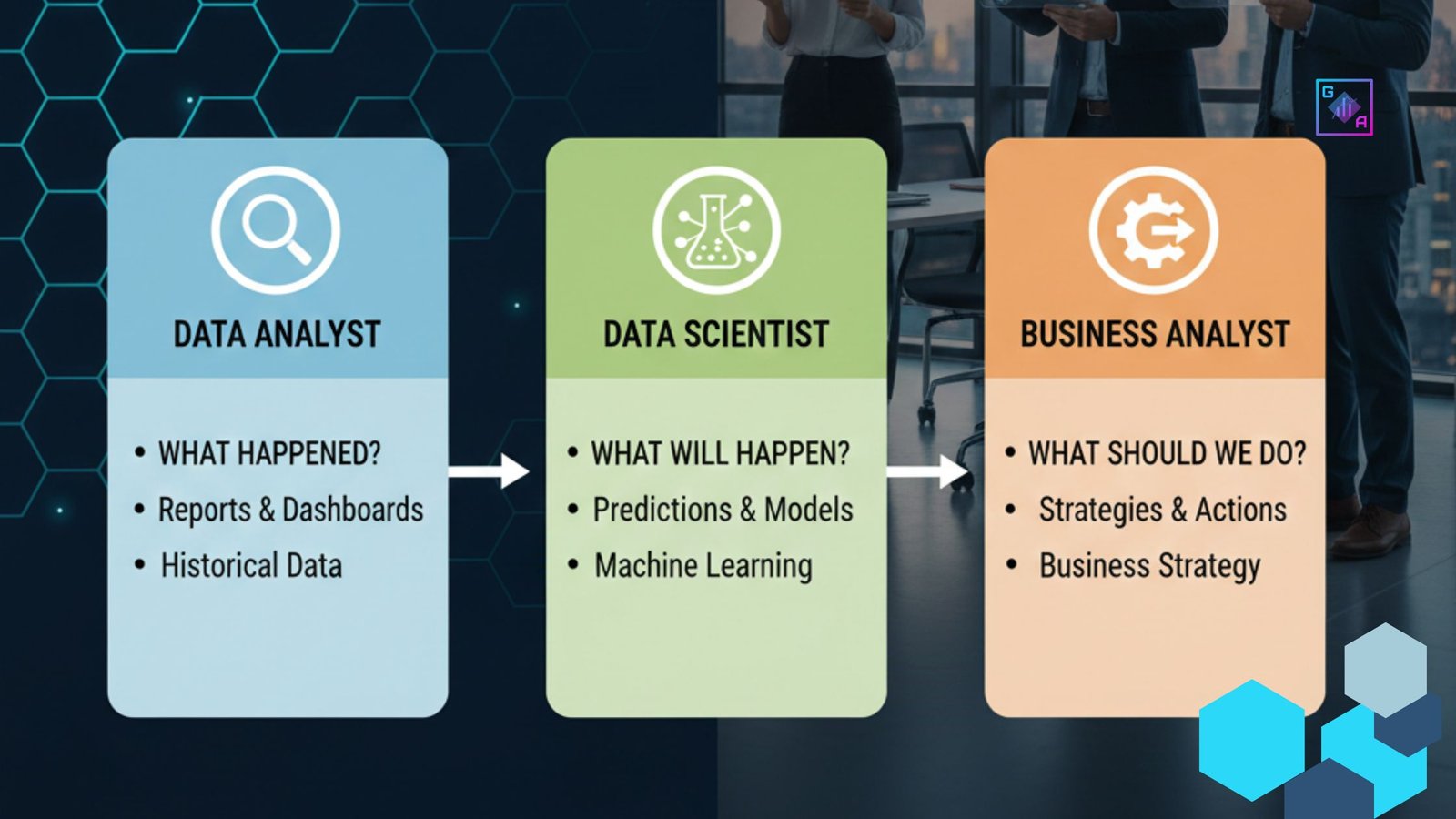
A data analyst focuses on analyzing structured data to identify trends, patterns, and insights.
Key Responsibilities
- Data cleaning and preparation
- Creating reports and dashboards
- Answering business questions
Skills Required
- Excel
- SQL
- Power BI / Tableau
- Basic statistics
2. Data Scientist
Role Overview
A data scientist works on complex datasets, predictive modeling, and machine learning.
Key Responsibilities
- Building predictive models
- Advanced statistical analysis
- Working with large datasets
Skills Required
- Python / R
- Machine learning
- Statistics
- Data modeling
3. Business Analyst
Role Overview
A business analyst acts as a bridge between business stakeholders and technical teams.
Key Responsibilities
- Requirement gathering
- Process analysis
- Stakeholder communication
Skills Required
- Domain knowledge
- Communication skills
- Documentation
Comparison Table
| Role | Technical Depth | Business Focus |
| Data Analyst | Medium | Medium |
| Data Scientist | High | Medium |
| Business Analyst | Low–Medium | High |
Which Role Should You Choose?
- Choose Data Analyst if you enjoy data and visualization
- Choose Data Scientist if you like advanced analytics and coding
- Choose Business Analyst if you prefer strategy and communication
Conclusion
Understanding the difference between analytics roles helps you build a focused career path and acquire the right skills for long-term growth.